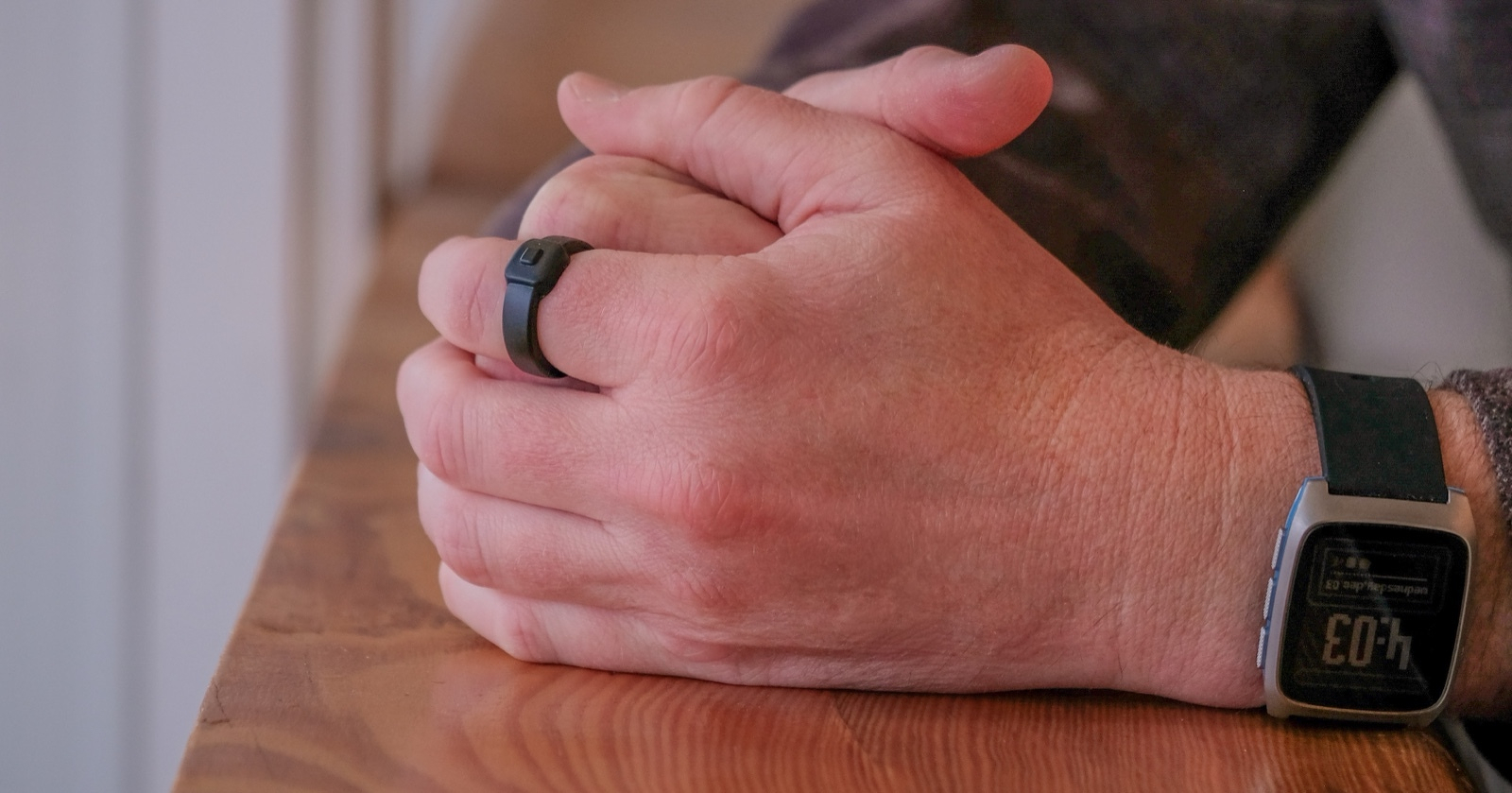
This episode of Version History got me looking back at 2012 and realizing what a wonderfully weird time it was for gadgets. Modern smartphones were only about 5 years old, and companies took that opportunity to try out all sorts of weird tech. Most of it wasn’t that good, but it was interesting. We’re firmly out of that era now. We’ve realized that apps on a smartphone kind of do most things; we’ve figured out what wearables look like and can do; it’s a cycle of iteration around fixed-category ideas.
So when a weird gadget comes out now, I still get excited. Enter the Pebble Index 01. I mean, outside of the new product, it’s a new product from Pebble, a company that was acquired by Google. Now reemerged, selling new-old stock watches, I wasn’t expecting something out of left field. Yet we have a genuinely weird smart ring.
What’s so weird about it?
1. It’s a smart ring with no fitness features
The smart ring market has been growing steadily, but still doesn’t feel mainstream. It’s popular with athletes and the fitness-body quantification types. And for people who want to regularly wear non-smartwatches without losing some body metrics. But it’s not the most significant market to begin with. My parents know smartwatches exist, but I don’t think they’ve heard of smart rings. That’s my rubric anyway.
But Oura and Samsung have clearly staked out that a smart ring needs to be about health tracking. The Index is a much simpler device. It has a button and a microphone. It’s designed to seamlessly take voice notes. That’s it. That is very weird. There is a large “second brain” community online that builds fantastic mind-mapping systems in Notion or Obsidian. I imagine this appeals to that crowd.
2. It’s non-rechargeable
That’s right, this is designed to be an ultra-low power device that can last for years on a charge. But when the battery goes flat, it is garbage. That’s a weird design choice. Now, every smart ring is unrepairable to begin with (to say nothing of most smartwatches until recently). So, Pebble is not being a particularly bad actor in the market when it comes to longevity. Still, it is a deeply weird move to explicitly design disposable tech. In some ways, it is more transparent than a lot of other device makers, which make devices with batteries that effectively can’t be replaced. Those too are designed to be thrown out. Pebble is just saying the quiet part out loud. And Pebble chief Eric Migicovsky said it will offer a recycling program.
This is still a deeply weird design choice.
3. No subscription
Pebble is selling a device with the Index 01, not specifically a platform. That means you get full functionality for the life of the device (which we’ve already established is very much fixed) at the purchase price. Pebble is quick to differentiate this from other smart rings. But the functionality is so distinct, the comparison rings (folks) a little hollow. A smartwatch can take voice notes all day without a subscription. And it offers you a display, a speaker, the ability to send and receive information.
4. It’s open source
Because the ring syncs through the Pebble app, which is open source, there are many potential integrations the company highlighted in its launch post. Essentially, you could pair the voice input and button interaction with anything. One button press to do a voice memo. Two presses to do a ChatGPT search. You could have the button trigger something entirely outside of voice apps. It’s a limited set of possibilities, and someone actually has to go out and build them. But there are some weird, if interesting possibilities. Likely none of them will ship with the device, but if the history of Pebble has shown anything, they can cultivate a fervent fanbase.
What is this thing?
Because Pebble is now entirely under Migicovsky’s aegis again, I think this device deeply appeals to him. He owns a wearable company; he has the right to try to sell a wearable that directly appeals to himself. As much as a “second brain” device, this is also in the class of a remedy for distracting screens. Just like dumb phones, Boox Palmas, and other such devices, they offer the tantalzing possibility to be more “in the moment” with your life. A laudable goal. Pebble rightly points out in it’s launch post that to do this, it needs to work every time, because one failed note will send you right back to your phone. I like that the Index can do some limited recording even if it loses connection, and then sync back later. And I like that it will sync with your phone to let you see your notes and recordings. Little things like that give me hope it could work.But I also think this is the start of Pebble own kind of lo-fi ecosystem. There’s a vision here. It’s kind of disaggregating some of the functions of the phone into limited devices that do less with much better battery life, while still punting back to the phone for connectivity and processing grunt. This isn’t Pebble’s first attempt at this. Is the next step another try at the Pebble Core? I believe it was only ever announced, but the Core was another step in this disaggregation. It was a 3G connectivity puck that could stream music and track GPS, designed to let you leave the house with your watch with minimal compromises. The Index is a much more humble device, but it speaks to the same ambition.